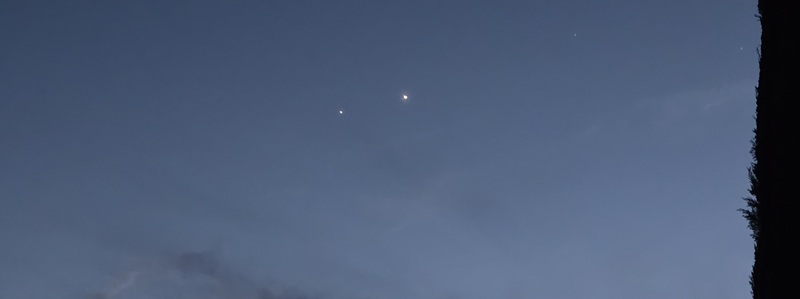

Dark
Natural darkness is a precious resource. By caring for it and protecting it, it can be available for future generations.
Whether in wilderness, rural or urban spaces, natural darkness is necessary for ecological integrity including sustainably healthy human lives.
Our ecosystems have relied on the balance of the day/night cycle for millions of years. Witness the plethora of nocturnal animals from owls and other birds to mammals like rabbits and deer as well as insects including moths and butterflies. And humans are part of this ecosystem.
Humans need distinct day and night for maintaining our body’s regulation – for more than and including sleep – for demonstrable health impacts. For most of us, seeing the Milky Way or a sky dotted with brilliant stars is a source of wonder and inspiration. Dark skies are important for astronomical research facilities where the instruments are sensitive to small amounts of stray light competing with the distant stars they are observing.
Light
Night-time outdoor lighting is also a valuable resource to ensure safe nighttime activities when done mindfully with a purpose.
This can be accomplished by using only the amount of light necessary, strategically positioning it, and using the appropriate warmth of light for nighttime.
This avoids glare which can blind you and excessive brightness which degrades the view of the night sky. This also saves money and resources when replacing unnecessary bright lighting. Some communities have adopted codes that are practical to implement to help comply with strategic lighting.
How bright is the darkness?
One of the easiest ways to identify the brightness of your night sky is to use the Bortle scale.
As Amateur astronomer – you guessed it – John Bortle created it in 2001, ranking darkness from 1 to 9, darkest to brightest. You can read his original article published in Sky & Telescope magazine in 2006.
Its goal was to help amateur astronomers get a better understanding of the darkness of a particular observing site. It uses practical celestial observations to estimate the overall brightness of the sky.
As I am not an astronomer, I needed some definitions in order to make sense of some of the descriptions.
- Zodiacal light has a tall, triangular shape, leaning to the left in the northern hemisphere, following the ecliptic You can see it away from any artificial lights on a low western horizon shortly after sunset on a moonless evening, appearing as twilight fades. The zodiacal light is the combined glow of countless tiny particles which are debris from comets and asteroid collisions orbiting the Sun. Like the dust in an unswept room, their mass is minuscule but their combined surface area is quite large, so they reflect a lot of sunlight.
- Zodiacal band is the faint band of light seen along the ecliptic, the path the sun takes through the sky. It is due to sunlight scattering off interplanetary dust particles.
- Gegenschein is German for counterglow, a diffuse spot visible only in the darkest of skies, centered at the point directly opposite the sun. Like the zodiacal light and band, it is sunlight reflecting on interplanetary dust. This is a stargazers’ holy grail to see and photograph.
And some help in locating referenced Meisner objects:
- Spiral galaxy M33 is located near the triangle-shaped constellation Triangulum, earning it the nickname the Triangulum galaxy. M33 has a relatively bright apparent magnitude of 5.7, making it one of the most distant objects that keen-eyed observers can view with the unaided eye under exceptionally clear and dark skies.
- Globular cluster M4 – Bright red Antares is easy to find in the prominent zodiacal constellation Scorpius the Scorpion. And if you look just slightly west of it through binoculars, you’ll see a small faint diffuse ball of light. That’s Messier 4, called M4 for short. It’s a globular star cluster, an ancient member of our Milky Way galaxy. M4 shines at magnitude +5.9, so it may be visible as a smudge on the sky under very dark skies. – Earth Sky
- Globular Cluster M5 is in the constellation Serpens Caput (the Serpent’s Head), so it is visible all summer. From the Northern Hemisphere, it’s visible in the evening sky starting in May and reaches its highest point in the sky in July. Around September it’s gone by midnight. Using a fist at arm’s length for a guide, M5 resides a good two fist-widths to the southeast of yellow-orange Arcturus, summertime’s brightest star. M5 is also three fist-widths to the east of blue-white Spica, the brightest star in the constellation Virgo. Plus, M5 is about one fist-width to the north (above) Zubeneschamali. So these stars give you at least a rough idea of M5’s whereabouts in the heavens.. – Earth Sky
The Bortle Scale
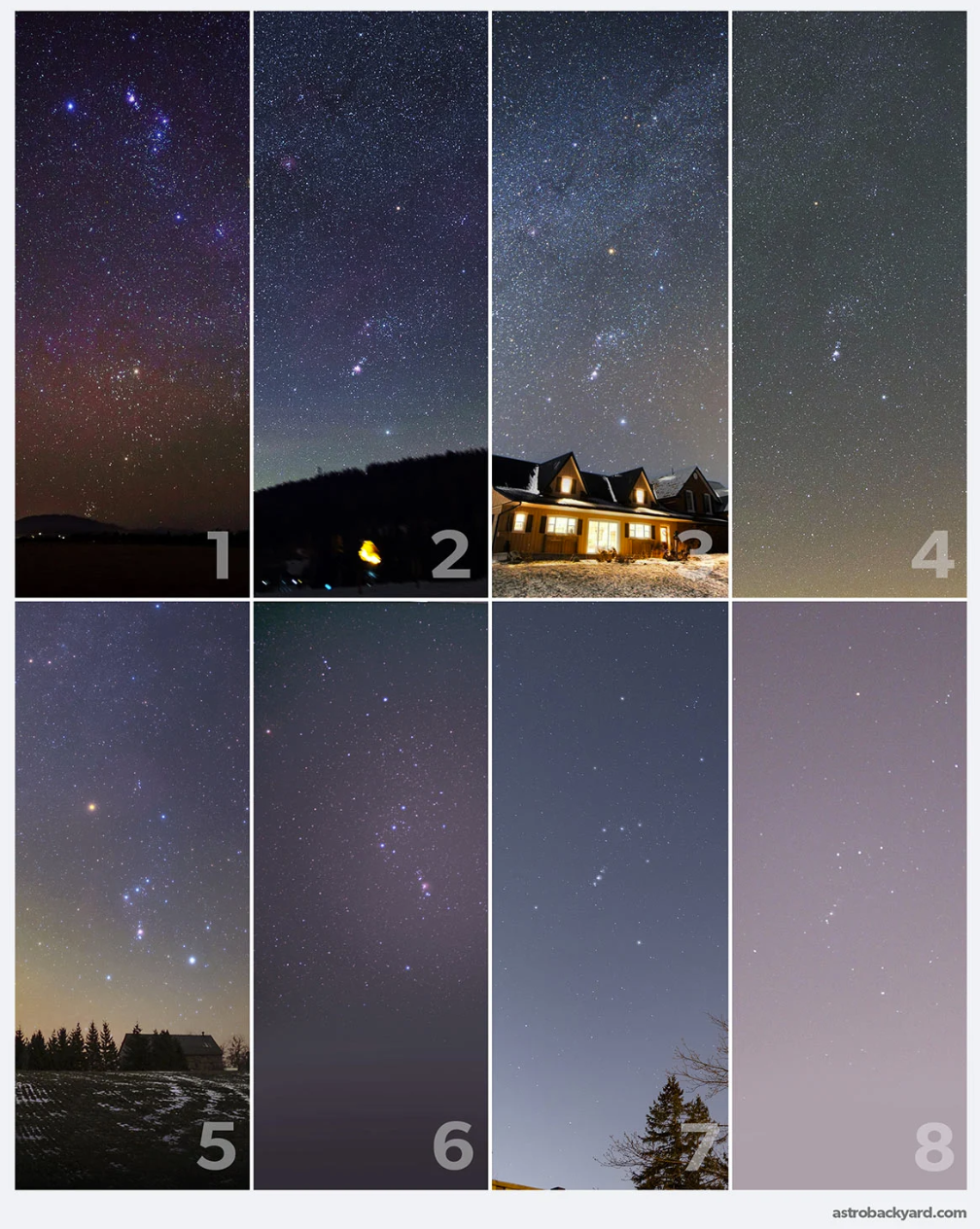
Class 1: Excellent dark-sky site
Class 2: Typical truly dark site
Class 3: Rural sky
Class 4: Rural/suburban transition
Class 5: Suburban sky
Class 6: Bright suburban sky
Class 7: Suburban/urban transition
Class 8: City sky
Class 9: Inner-city sky
Class 1: Excellent dark-sky site
- Zodiacal Light, Gegenschein, and Zodiacal Band Visible.
- M33 Galaxy is visible as a naked-eye object with direct vision.
- Scorpius and Sagittarius regions of the Milky Way cast diffuse shadows on the ground.
- Viewing Jupiter or Venus degrades the dark adaptation of your eyes.
Class 2: Typical truly dark site
- The summer Milky Way is highly structured to the unaided eye
- The brightest parts of the Milky Way look like “veined marble” when viewed with binoculars.
- Zodiacal light is bright enough to cast weak shadows.
- Clouds in the sky are visible only as dark holes in a starry background.
- Several Messier globular clusters appear as naked-eye objects.
Class 3: Rural sky
- Slight signs of light pollution along the horizon.
- Clouds appear faintly illuminated in the brightest parts of the sky.
- The Milky Way still appears complex.
- Globular clusters M4, M5, M15, and M22 are all distinct naked-eye objects.
- M33 is easy to see with averted vision.
- The zodiacal light is striking in spring and autumn.
Class 4: Rural/suburban transition
- Fairly obvious light-pollution domes are apparent over population centers.
- Zodiacal light is clearly evident but doesn’t even extend halfway to the zenith.
- The Milky Way well above the horizon is impressive but lacks all but the most obvious structure.
- M33 is a difficult averted-vision object.
- Clouds in the direction of light pollution sources are illuminated but only slightly.
Class 5: Suburban sky
- Hints of the zodiacal light are seen on the best spring and autumn nights.
- The Milky Way is very weak or invisible near the horizon and looks rather washed out overhead.
- Light sources are evident in most if not all directions.
- Clouds are quite noticeably brighter than the sky itself.
Class 6: Bright suburban sky
- No trace of the zodiacal light can be seen.
- The Milky Way is apparent only toward the zenith.
- The sky within 35° of the horizon glows grayish-white.
- Clouds anywhere in the sky appear fairly bright.
- M33 is impossible to see without binoculars, and M31 is only modestly apparent to the unaided eye.
Class 7: Suburban/urban transition
- The entire sky background has a vague, grayish-white hue.
- Strong light sources are evident in all directions.
- The Milky Way is totally invisible or nearly so.
- M44 or M31 may be glimpsed with the unaided eye but are very indistinct.
- Clouds are brilliantly lit.
- Even in moderate-sized telescopes, the brightest Messier objects are pale ghosts of their true selves.
Class 8: City sky
- The sky glows whitish gray or orange.
- M31 and M44 may be barely glimpsed by an experienced observer on good nights.
- Only the bright Messier objects are detectable with a modest-sized telescope.
- Some of the stars making up the familiar constellation patterns are difficult to see.
Class 9: Inner-city sky
- The entire sky is brightly lit, even at the zenith.
- Stars making up familiar constellation figures are invisible.
- Dim constellations such as Cancer and Pisces are not seen at all.
- Aside from the Pleiades, no Messier objects are visible to the unaided eye.
What is Your Location’s Darkness?
If you are not an astronomer, even an amateur one, you may just want to look it up on an online map.
You can click on a location and it can tell you where on the Bortle scale it is, in other words, the brightness or darkness of the night sky.
This map shows a large city from white to red going outwards, and rural areas appear green to blue. These colors represent the amount of artificial light in the area impacting how bright the night sky will look.
It says my backyard is probably 4.6 – visible but lacks detail.
To help preserve and restore natural darkness, check out the Dark Sky International website.