
In Mastering Hunger, part 1, I mentioned the three types of hunger. These three types are described by Jason Fung in his book The Hunger Code:
- Homeostatic hunger — triggered by the body’s need for fuel
- Hedonistic hunger — triggered by emotions and pleasure
- Conditioned hunger – triggered by environmental cues
Part 2 is all about the first, Homeostatic Hunger.
Homeostatic Hunger: The Body’s Fat Thermostat
Homeostatic hunger is the body’s self-regulating system to maintain weight. It is regulated by hormones.
When hungry, you may experience:
- Stomach growling
- Low energy because the blood sugar level drops
The body has a set weight. This is homeostasis:
- When weight is above the optimal point, the body activates mechanisms to lose weight.
- When weight is below the optimal point, the body activates mechanisms to gain weight.
This shows why lean people have no trouble losing weight, while overweight people have much more trouble—and the weight does not stay off.
Hormonal Controls of Homeostatic Hunger
The mechanisms that control homeostatic hunger are hormonal and neural, not simply calories.
Willpower will not reset the homeostatic set point, and you can’t simply decide to be less hungry.
These hormonal controls include:
- Leptin — tells you to stop eating.
- Stomach distention via the vagus nerve
- Incretins
- GLP-1 — glucagon-like peptide (semaglutide)
- GIP — glucose-dependent insulinotropic polypeptide (tirzepatide)
- Sympathetic tone: Adrenalin, Noradrenaline
- Stimulation of the SNS, as with drugs such as nicotine, amphetamines, and fenfluramine, leads to weight loss.
- Blocking the SNS, as with beta blockers, leads to weight gain.
- Sex hormones
- Testosterone — gain muscle, lose fat
- Estrogen — gain fat
- Progesterone — increase appetite and fat
- Thyroid hormones
- Excessively high — lose weight
- Excessively low — gain weight
- Brain reward pathways: Dopamine. Serotonin
- Interfering with these pathways, as with antipsychotic or antidepressant medications, can cause weight gain.
- Blocking them, as with naltrexone and bupropion, can cause weight loss.
- Ghrelin — stimulates appetite and is conditioned to peak before you habitually eat.
- Satiety hormones: Peptide YY, Cholecystokinin
But the biggest hormonal influence is from insulin.
Insulin
What happens to insulin when we eat and when we don’t eat, or fast?
When we eat it is The Fed state, a state of storing energy.
- Insulin increases.
- Increased insulin tells the body to store energy as fat.
Fasting is taking a break from eating, allowing the body to burn stored fat and cleanse. The fasted state is a state of burning energy.
- Insulin decreases.
- Decreased insulin tells the body to burn fat.
- The body has adapted to not die while sleeping: it burns stored sugar or fat for energy.
Insulin triggers the switch from fed to fasted. It’s this simple.
- Staying in the fasted state longer is the fastest and most efficient method of reducing insulin.
- Note that calorie restriction does not usually lower insulin levels, and that’s a big difference.
- In fact, If you miss a meal, the hormone (ghrelin) that peaked to make you physiologically hungry fades away. And when fasting for several days, that hormone (ghrelin) drops overall, reducing hunger after the fast.
Low-Insulin Eating
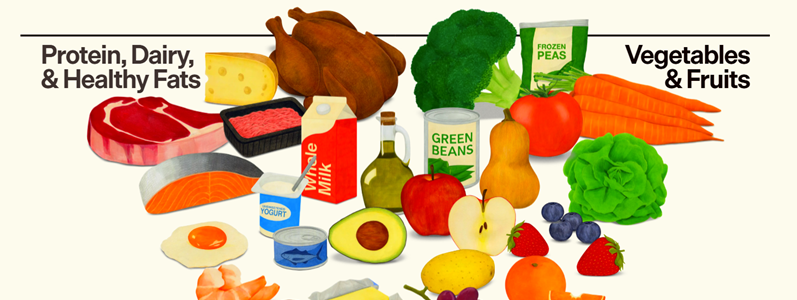
By the way, the Dietary Goals for the United States presented in 1980 had no science backing. In 2025, the food pyramid was turned on its head, suggesting to Eat Real Food. This does have scientific backing.
The macro nutrients that influence insulin are protein, carbohydrates, and fats. A high-plant diet, full of real food, tends to be higher in carbohydrates. This stimulates more of an insulin surge. We want to eat plants, so there are some strategies. You can mitigate the surge of insulin if the carbohydrate has:
- Slowly digested starch
- Resistant starch
- Fiber
In addition, the glycemic index measures how quickly carbohydrates are digested and absorbed by measuring the resulting blood glucose levels. You can choose lower glycemic foods.
To reduce the impact of carbohydrates:
- Choose whole fruits, not cooked, pureed, or juiced fruits.
- Choose lower-fructose fruits, such as berries, instead of grapes, oranges, or watermelon.
- Choose thicker viscosity for liquids, such as thick soup, or add chia seeds.
- Include acidic foods, such as vinegar, lemon juice, pickled foods, and fermented foods.
- Have protein and fat with the carbohydrate, never the carbohydrate by itself.
- Eat meals earlier in the day to decrease hunger and increase fullness.
Protein and Fat
Fat does not need insulin to be used for fuel, so there is no insulin surge when eating fat.
However, fat most often naturally occurs with protein. Think of a marbled steak, the fat under the chicken skin, the oils in seeds, and so on.
Eating protein does have an insulin response, but it is much much less than carbohydrates. And it is further mitigated with the fat occurring with it. In fact, we mostly don’t count it.
There are two more kinds of Hunger
The next part in this series deals with the kinds of hunger that do not feed a physiological need for fuel. They are valid forms of hunger, as we will see, and yet they often cause the most trouble.